Digital Advertising Predictions

The world of digital advertising is an ever expanding and evolving creature as marketers continue to learn about what people what, how to bring them what they want, and when. With the rise in trends like the use of social media and influencers to advertise a brand, as well as social listening to bring personalized advertising to consumers it’s amazing to think of where the world of advertising will go next. This week we have been asked to discuss our predictions, specifically three, regarding technology, trends, or strategies in the world of digital advertising that we think will take off or grow in the next five years. Let’s look into the future and take a peek at what the new age of advertising might be like.

AI: Artificial Intelligence

Artificial Intelligence (AI) is honestly something that scares me a bit. With all the media there is out there regarding AI going rogue and wiping out humanity I can’t help but be a little frighten. It does seem that digital advertisers are going to be embracing AI in the near future. AI can easily analyze data from numerous sources at once giving advertisers a leg up on know how and where consumers find the products and services they need. One way we currently use AI is through chat-bots which use natural language processing software to read and respond to customer inquires as if they were talking to real person. According an article (linked below) MasterCard currently has a Facebook Messenger AI chat-bot is uses in this way which can even take customer payments. How does adopting AI affect a company positively? Well it allows for a company to cut staffing costs and grow larger. If their competitors are having to staff positions to do the things the AI can do it give them the leg up. That usually how the movies start though, the AI comes in and takes all the human jobs away so hopefully the advancements won’t destroy the job market.

It Gets Personal

Personalization has already become a huge marketing tactic used by brands all over the world and it’s only going to get more widely used. Of course we all know that companies like Netflix and Amazon can cater to your every whim by using things you’ve already bought, watched, or looked at, and suggest similar items or shows. According to this article it’s already more widespread with companies like Cadbury and Starbucks using social media information, past purchases, and location to better meet the needs and wants of their customers. I think with the rise of AI comes a rise in personalization and it won’t be long until we see grocery and drug stores using personalize recommendations via apps that use your prior purchase data to create shopping lists automatically. Even though AI scares me a bit I am definitely among those who enjoy a personalize advertising experience, even though sometimes it can be creepy when I talk to someone about a product and them 5 minutes later I see an ad for it on Facebook. I’ve accepted that this is the way of the world now.

Influencers Are The New Celebrities

When I was younger celebrity endorsements were all the rage and I remember seeing commercials for work out machines with the likes of Chuck Norris. Now instead of celebrities, influencers are used to advertise products and services. In a similar fashion both celebrities and influencers have large built in consumer followings that can be easily marketed to. The biggest difference I find is that influencers have the opportunity to take a more genuine approach as many people thinks of these influencers as a friend and thus product recommendations feel more real. According to the article, once again linked below, “63% of consumers trust influencers’ opinions of products much more than what brands say about themselves,” and “58% of people have bought a new product in the past six months because of an influencer’s recommendation.” I personally know I have purchased items that have been recommended by influencers I follow and while the platforms of YouTube and Instagram are popular I’ve seen Snapchat and even TicTok used for marketing now. Whatever the new hot platform is you can bet that anyone with a large following will be used to market to their audience, it only makes sense.

So those are my three predictions of how marketing will continue to grow in the next five years or so. I’ll have to come back in five or so years and see if I was right. If you want to comment and let me know what you think regarding my predictions or if you have any predictions of your own I’d love to hear them. In the meantime, remember: be weary of artificial intelligence, no matter how convenient it might be!

References:

Dave, N. D. N. (2019, December 7). 42 Digital Marketing Trends You Can’t Ignore in 2020. Retrieved February 11, 2020, from https://www.singlegrain.com/digital-marketing/digital-marketing-trends-2020/

Marketing Perspective

Influence. According to Merriam-Webster the word ‘influence’ is defined as: “the power or capacity of causing an effect in indirect or intangible ways.” The word has been around since the 14th century and yet is more prevalent now than ever before with the rise of the influencer. Merriam-Webster goes on to define an influencer as: “one who exerts influence a person who inspires or guides the actions of others.” However, the second and most often used definition today is: “a person who is able to generate interest in something (such as a consumer product) by posting about it on social media.” This week we were asked to read a transcript of a 60 Minutes segment called The Influencers and answer a few questions about influencers we may follow. As YouTube’s Rosanna Pansino would say:

Do you follow any influencers?

I definitely follow a few influencers but I feel like lately I have backed off from following a lot of the once I used to like. A lot of the people I enjoyed I saw as real people making videos or streaming video games and in the years since have, in my opinion, become more like selling machines than people. I used to follow Nerdy Nummies on YouTube because I loved seeing Rosanna Pansino make sweet treats that were nerdy and doable but now a lot of her content feels like an advertisement for her baking line, which is really unfortunate. One of the people who’s content has been consistantly entertaining, real, and even includes paid promotions every once and a while is Grace Helbig on YouTube. Though out the years she has remained herself, even when partnering with brands, and never compromised what she wanted to do to sell a product.

What do you notice about this type of marketing?

What I’ve noticed is that is can be pretty risky but the reward can be great. If you look at someone like Logan Paul who has a HUGE following of young fans that’s chance of selling a product to a HUGE amount of people but it also has a HUGE chance to go south fast. Logan Paul has gone through many a scandal and brands that associated with him were called upon to respond during these scandalous events. In an article from mediakix.com entitled Should Your Brand Work With Controversial Influencers? the author looks over the controversies that Logan Paul has been in and all the backlash he and YouTube have both suffered from users and from advertisers. I agree with the sentiment at the end of the article that advises to proceed with caution but I also believe that it all depends on who you work with!

What strategies are they (the influencers you follow) employing?

I think the biggest one is being genuine, that’s the whole point of an influencer in my opinion. It’s great to have a big following and a name behind your brand but if all their focused on is selling and don’t care about the product or how it will effect their fan base it feels fake. In the case of Grace Helbig on YouTube she does a monthly video that’s a brand deal with HelloFresh, the meal kit delivery service. In these videos she chooses one of the kits, makes it (usually what enjoying some shot of Tito’s,) and invites her subscribers to guess where she’ll mess up! In all actuality she usually does a pretty good job, the meals come together, and it allows her to confidently say “if an idiot like me can do it, so can you!” The beauty of this is besides the talking points she has to get out, HelloFresh allows her the freedom to make the videos in a way that will best appeal to her audience because she knows them best. It’s a smart strategy on the part of the company to allow the freedom of creation because that’s what influencers on YouTube do and that’s what makes it feel truly genuine.

What role to influencers play in marketing?

Influencers plays the part of the middle man, between the brand and the consumer. To the brand they are a tool to sell the product. To the consumer they are a friend or someone they admire. Thinking about this realistically: as a consumer are you more willing to believe a brand selling you a product or a friend/person you admire who tell you how great the product is? For me I know it’s the latter and that makes the influencers the bridge to the sale.

How does the use of marketing perspective impact the relationship between the company and consumer?

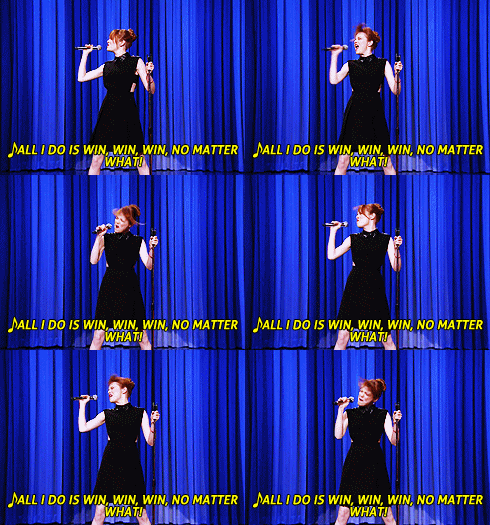
As mentioned before the company is always going to the see the consumer as dollars signs or money in the bank. The consumer is going to see the company as place to get what they need BUT something they need isn’t always what the company is selling. That’s where the influencers come in, to make the consumer realize the need and purchase from the company. I think this perspective is a bit skewed in a way I don’t like but I do feel it’s pretty real. Most companies are more worried about the money rather than the consumer, even though it’s the consumer that makes them the money. Influencers can be used to close that gap, make a company feel more personable, and show a consumer what they need. It’s a win, win, win!

Effectively Impacting the Consumer Through Social Media

This week in class has been all about building value with the consumer, gaining their loyalty, and keeping it. We’ve talked a lot about how brands reach consumers in different ways using digital and social media and gotten to analyze how we as consumers are reached by brands that we are loyal to. In this post we’ll be looking at one of three specific examples of digital media and answering a few questions about how they reach their target market, how they addressed social and consumer experience, how they handle their followers, and how efficiently this was all done. The three examples we had to choose from were Whirlpool, The Voice, and Tale of the Tiger. Of these three my choice was simple, I decided to look into…

As a frequent singer myself you’d think that NBC’s The Voice would be something that I’d watch regularly. In that though you would be wrong. When The Voice premiered in the spring of 2011 I was thoroughly excited for it but was very disappointed when I realized the concept was not what I originally thought. In the beginning I was under the impression that the entire competition would be like the blind audition phase and the judges wouldn’t be able to see the winner until the end of the finale. Whether this misunderstanding was my fault or the fault of the advertising is hard to say but what I can say is I was in the minority of people who were disappointed with the show and it has continued with great success. Before we continue a quick breakdown of what The Voice is for those who may not know. According to the Wikipedia for The Voice:

The series employs a panel of four coaches who critique the artists’ performances and guide their teams of selected artists through the remainder of the season. They also compete to ensure that their act wins the competition, thus making them the winning coach.

The Voice (American TV series) Wikipedia Article

So now that we know a little bit about The Voice, let’s get right down to the questions.

What was done successfully to meet the wants and needs of the target audience?

What does the target audience of The Voice really want? They want to be entertained and they want an experience. I think The Voice delivers this very well and they’ve done something we hadn’t seen before which is making live television truly interactive. While the live show is taking place you can tweet and it could show up on your screen. You can even use the app to vote to save a contestant from elimination in real time! No other show that I know of has done something this monumental, this real, or this immediate.

The idea of voting to eliminate or save someone isn’t knew Fox’s American Idol and ABC’s Dancing With the Stars use this tactic for audience engagement but most of the time participants are given a time frame to vote in, it’s not completed in real time like it is on The Voice. CBS’s Big Brother, where a group of strangers are sequestered in a house, have challenges, and vote each other out each week, was an innovative show because it brought behind the idea of extra content to the forefront. You could pay to log on the the website and watch the house camera’s 24 hours a day, 7 days a week with a few exceptions. The Voice does extra content well too, with the extra stories, news feeds, and behind the scenes content and it’s all free.

The Voice uses all this and more to be a step above the other reality competitions shows or even music competitions shows. They deliver entertainment, excitement, and a well rounded and fun experience each season! These are the things that make them successful in meeting the needs and wants of their target market.

How was the social and consumer experience addressed? Was this done successfully? Explain.

Social and consumer experience is address with the idea the interactivity is everything. hashtags on Twitter, SnapChat filters and takeovers, Instagram stories, they’re all meant to saturate the social atmosphere and promote sharing, liking, commenting. The show itself does this too allow consumers to directly see reactions and responses on social media in a segment they call Skybox. This is a very important tie in because sometimes tweeting or even using hashtags on Instagram can feel like shouting into the void or the crowd. This way people see that their social interaction with this brand means something. I definitely think this was all addressed successfully as it even though they are running on almost all platforms it doesn’t seem too much. As someone who isn’t a fan I’ve never found myself saying, “why is that show The Voice everywhere? I’m sick of it,” and I can easily see how fans would really enjoy the entire experience. Of course seeing the numbers allows you to measure success as well and the Shorty Awards page for The Voice gave the following stats which I think are a great measure of the overall success they’ve seen:

  • Twitter
    • The most tweeted series of 2015 on Twitter! (Source: Nielsen, ranked on unique authors/tweets)
    • The Voice on 12/8/15 is the most social reality series episode of 2015 (Source: Nielsen, ranked on unique authors/tweets 282,900 people sent 1.4 million Tweets about The Voice on 12/8/15 and 2.3 million people saw those Tweets a total of 15.7 million times.
    • The Voice episode on 12/8/15 garnered the most tweeted series minute of 2015 with 216,587 Tweets at 8:53 pm ET after people were tweeting their votes.
    • We beat ourselves for the top tweeted minute. Previously, it was The Voice on 4/28/15 at 8:57 pm ET with 182,000 Tweets.
    • Most followed TV entertainment series on cable and broadcast (Listen First)
  • Facebook: Most likes of any reality series on broadcast and cable
  • YouTube: Most subscribers of any reality series on broadcast and cable
  • Vine: Most followers of any reality series on broadcast

How were the digital media followers handled?

Followers of digital media for The Voice are treated like active participants and collaborators, which of course they are. Everything we’ve already mentioned goes to show how they strive to include their followers and fans every step of the way. I think it’s really amazing that a show can give that much to the fans but in the same way are getting so much back. It just goes to show the real power behind UGC (User Generated Content.)

Is there something that could have been done differently to make that experience more efficient?

The Voice is pretty efficient with it’s social and digital presence but I think if I had one this to recommend it would be to sick with one or two socials and not all. From what we’ve read and learned so far it seems like an obvious thing to suggest as focusing on a specific medium helps you dive in and reach the target market better there. I do however think The Voice does an excellent job a covering their bases and no one social platform seems underused. The numbers don’t lie, and they’ve seen massive success on Twitter, Facebook, YouTube, and Vine (when it was still around… RIP Vine.)

In conclusion…

…The Voice does an AMAZING job at making something that can be so passive (watching TV) active and exciting which it was their target market is really looking for. Personally after writing this I might have to give the show another chance as it’s been a while and I’m sure a lot has changed about it from those first two seasons. Even now there a show to meet my original expectation of what I thought The Voice was, The Masked Singer. I’m going to go now and take a peak a both of these shows but before I do I’ll leave you with one of my favorite Vines on honor it’s memory. Enjoy!

A Day In The Life

My day starts just like any other 30 somethings, by waking up, rolling out of bed, and walking out into the kitchen where my waitstaff is plating up my organic gourmet breakfast. I take my plate out to the balcony where I watch the sun rise over the hills and think about how lucky I am to have gotten here. Then I wake up from the crazy dream I’m having and glue my eyes to my phone to see what’s going on in the world.

I think most people, myself included, are wash in social media over the course of their daily lives. Checking Facebook, Twitter, and Instagram has become part of the routine. I know one of the first things I do when I wake up is check all my notifications that popped on my phone over the last 8 hours or so of sleep. It’s ingrained in our society now to be a connected as possible to one another, even if we may be thousands of miles away.

This week we have been asked to go through a number of questions regarding how we use digital media on a daily basis. I invite you to think about how you use digital media too, as I find it very interesting how different people consume the same available media differently. Anyway, on to the questions!

What sites and/or applications do you visit most often? Describe the sites and applications that you identify.

So according to the Screen Time function on my I-Phone I use Social Networking apps most often, in the past seven days I have been on these apps for almost 44 hours total. The applications I use the most include the video calling app Skype, the micro-blogging app Twitter, the text chat app Messenger (Facebook Messenger,) and the social media app Facebook. Also included in smaller increments are Discord, another text and voice chat app usually used for “gamers,” the image/blog app Instagram, and the temporary photo app Snapchat. Other than these Social Networking apps the apps I used the most often were under the entertainment category and those were the video sharing site YouTube and Apple Podcasts app. This information actual give a good breakdown of the apps I was under the impression I used most often on a daily basis.

Do you have positive or negative reactions when using certain types of digital media?

OH definitely and it all depends on the type of media and how the media is being used and presented to me. Being a HUGE consumer of content on YouTube I am used to seeing pre-video, post-video, and mid-roll ads during most of my content. I’m pretty neutral about the experience as I understand these ad often contribute to the money the creator of the content makes. The one type of ad here I can’t stand is political ads as I find them to be mostly obnoxious and find that enough of them run on television I don’t want to see them on YouTube as well. I also know that the ads that are run on videos have to do with the demographic of the viewers of that creator, or they are supposed to be, which makes sense in a marketing context.

As for positive experiences with digital media, I’ve recently gotten in to listening to podcast while I drive which has been a really great experience. I really enjoy hearing people discuss interests of mine and I find it keeps me engaged while driving. My favorite podcast currently are Why Won’t You Date Me, a podcast where comedian Nicole Byer discusses why she’s still single, Drag Her, a RuPaul’s Drag Race recap podcast, Musical’s Taught Me Everything I Know, a comprehensive look at a new musical every episode and the lesson we learn from them. I highly recommend them.

Do you find that your needs are satisfied using one type of digital media over another?

I think so! I find that different needs suit different digital media differently. I use Facebook to keep up with friends from high school and college. Doing so wouldn’t work as well on Twitter. Twitter I use to keep up to date with trending topics and content creators that I like which wouldn’t work as well on Instagram for me. Instagram is for seeing snapshots of my friends and family during their day to day lives. Not exactly something I can do easily on Snapchat. Each type of digital media has it’s place. While a lot of these apps offer similar features, the quality and ease of use is different on each. I could never see myself trying to play a game with friends but using Skype to keep in touch, Discord just works better. And video on Discord is still in beta but that’s fine because all I need is the audio when playing a game with friends.

Do you receive emails from companies? If so, what types of email catch your attention? What do you look for?

I am the KING of company emails. I’ve been trying for a while to weed out the ones I don’t actually look at by unsubscribing but it never seems to get any better. I think the emails that really catch my attention are the ones with subjects like “20% OFF ALL JEANS ONLINE TODAY” or “YOU’RE COUPON FOR 50% YOUR ENTIRE ORDER.” I tend to be a sucker for a sale or coupon. It also depends on the products or company that is sending it to me. 50% off a site that sells phone cases I bought from once isn’t as good as 50% off American Eagle or Kohl’s, two of the stores where I by most of my clothing. Emails need to tell me what their offering before I’ll even open them. If not, into the archive or deleted folder they go!

What do you notice about the use of digital media in marketing today? Explain.

The biggest thing I’ve noticed about the use of digital media in marketing today is that it’s EVERYWHERE. You can’t so much as turn on your phone or step out of your front door without having an add pop up. Yesterday I went to 711 on my work break and when I stepped in my phone pinged with a notification from 711 with deals because I had my location turned on and the 711 app downloaded. I don’t even remember downloading that app but I guess I did. It just goes to show how ingrained into our lives digital media is and how easy it can be to use it for marketing.

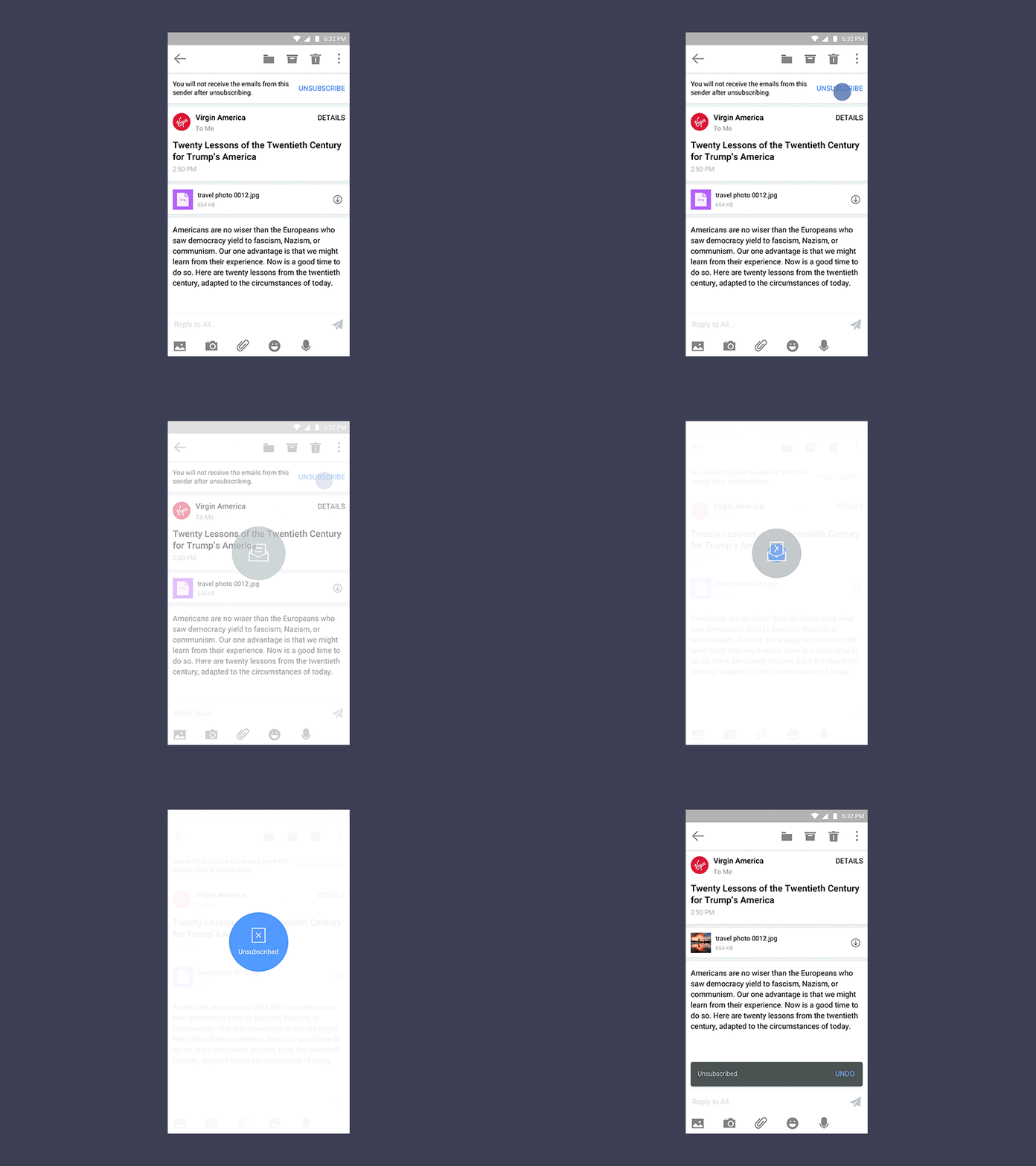
Now that we’re done I think I’m going to spend the next few hours unsubscribing from store mailing lists. I hope you’ve enjoyed reading my little deep dive into a day in my life with digital media.

Image result for unsubscribe email gif

Green for Profit or Green for the Environment?

Now-a-days what companies do behind the scenes and where their money goes is just as important as the products they produce and the customer service they give. This weeks module was all about social and ethical responsibility of businesses and how is can effect how a brand is perceived. If you found out that a company or brand was actively harming the environment during the production of their product would you still purchase that product? What about if they were donating money to a “cause” that you didn’t agree with? These are all things that brands need to be aware of in this age where consumers demand transparency.

So what is a company that I think is socially, environmentally, and ethically responsible? Well it’s everyone favorite place to shop where you always get more than you planned… Target.

Target, while being a great place to shop, has also seemed like a fairly ethical company to me. Upon doing a bit of research I was able to find that in an effort to be transparent they have begun to release a corporate social responsibility report each year. Their main goals for being socially responsible are to:

  • Empower Teams: Ensure team members and manufacturing supply chain workers thrive by providing competitive compensation and benefits, fostering a diverse and inclusive workplace, and striving to enhance worker safety, well-being and economic opportunity.
  • Serve Guests: Deliver value with values by offering better-for-you and sustainable products, services and experiences, building positive environmental and/or social impact into the way they make and market their owned brands, and offering products, services and experiences that bring joy.
  • Foster Communities: Accelerate economic development by bringing Target to communities where our presence and investment can foster economic vitality, inviting communities into spaces designed with their unique needs, and enabling community members to access economic opportunity through financial security and empowerment.
  • Design Tomorrow: Embrace future forward design by aiming to source and influence our suppliers to manufacture environmentally and socially responsible products, seek to establish a culture and mindset around circular design and zero waste lifestyles, and aspiring to design and operate the most sustainable buildings in the retail industry.

They also have a corporate responsibility page (which I have linked below with the PDF of the 2018 Social Responsibility report) that expounds a bit on the things mentioned above. While Target seems to be a large corporation grounded in socially responsible activities they weren’t always that way. The biggest issue they have had was back in 2011 when Lady Gaga broke off her partnership with them because she learned that they had donate money to political campaigns that supported anti-gay candidates. At that time many people I knew also stopped shopping at target and I’m fairly certain the business took a bit of a hit. Target clearly learned their lesson though as fast forward to May 2019 and Target made a large donation to a charity that helps stop bullying of LGBT+ students in school. A bit of a 180 switch which leads me to believe those donations, while intentional, were never intended to support anti-LGBT candidates and the company didn’t realize where it’s money was actually going.

So knowing what I know now do I feel Target is “green” for the environment or “green” for profit? My answer would be both! I think Target is a brand that has realized the importance of supporting certain causes and working on their own sustainability because while it helps the environment it also helps their wallets in the long run. It’s a fine balance that I think Target has perfected and other companies could learn a thing or two… but I won’t call any of those out in this post.

*cough**cough*walmart*cough*cough*

Corporate responsibility. (n.d.). Retrieved June 23, 2019, from https://corporate.target.com/corporate-responsibility

Future At Heart: 2018 Target Corporate Responsibility Report [PDF]. (2018). Target Brands Inc. https://corporate.target.com/_media/TargetCorp/csr/pdf/2018_corporate_responsibility_report.pdf

Top Dog Versus Underdog

This week we’ve been asked to watch a video of the Top 10 Business Rivalries and using what we learned in the reading this week examine which of the two brands is the top dog and which is the underdog, their brand strategies, why we think consumers prefer one brand over the other, and give 3 points of advice for the underdog to better their brand strategy. I was excited to see that one rivalry that is near and dear to my heart was on the list. That rivalry is the one between Marvel and DC. I’m a bit of a comic nerd myself and with the emergence of the Marvel and DC movie universes these large comic companies have become very mainstream.

When looking over the box office information for both of the companies it became very evident to me that Marvel is the top dog in this situation and DC is the underdog. Personally I wasn’t surprised. I’ve always been more interested in Marvel properties myself and have found the things they’ve created more compelling. I think this may have to do with the specific ways each company has crafted their brand.

Marvel has carefully crafted it’s brand in a specific and interesting way. They’ve clearly used more well known characters like Iron Man, Captain America, and Thor to introduce a movie universe and then tie it together with possibly lesser known characters like Hawkeye and Black Widow for the large scale crossover of the Avengers. This builds interests, adds drama, and a strong sense of continuity to their franchise. As the Marvel Cinematic Universe, the MCU, continued, it became more and more of a powerhouse and each move added new characters, with new varied levels of notoriety, and most were met with success. The release of The Black Panther shattered box office records and was only exceeded by the most reason MCU movie release, The Avengers: Endgame which was the ended of the second phase of the planned MCU. Marvel has build a brand from good stories, well crafted characters, and lots and lots of action. But what of DC.

DC has always done things a little differently. They always have been a bit edgier, a bit darker, and have seen some success doing so. Unfortunately their string of successes with the Batman Trilogy, which included the brilliant The Dark Knight, has also been plagued by some cinematic disasters (Suicide Squad anyone?!) For me it seem like DC has built a brand on being dark, being edgy, and relying heavily on known properties (like Batman and Superman) as well as famous actors (Ben Afleck and most recently Robert Pattenson as been announced as the new Batman.) Which this may initially draw people to their movies it doesn’t have a lasting effect. This to me seems like a bit of a “flash in the pan” effect.

I think people prefer Marvel over DC for one main reason, the quality of product. It seems to me that Marvel is concerned with creating a quality product that will draw people in with interesting stories and content connections. DC is far too concerned with being a counterpoint to this. It’s almost as if DC is shouting “look over here, we have stuff too.” For me there a few small things they could do better their brand.

  1. Create quality stories that connect known characters with less popular but interesting ones to craft a well rounded universe of dynamic events.
  2. Plan ahead- One of the biggest things Marvel did was to create a multi-phases plan from the beginning. As the plan went on they edited this plan but they always had A PLAN.
  3. Continuity- While both companies reboot their characters a TON (I’ve watched Uncle Ben in Spiderman die far to many times) Marvel has learned that continuity pays off and using their characters as part of the plan for a while is smart. This allows people to learn and connect with characters and the actors that play them.

Overall I think both companies do good work but Marvel has definitely perfected the art of creating stories, presenting characters, and weaving a consisting narrative. Even when we talk about some of their properties outside the Avengers (like the long running X-Men Movie Franchise) they just know how to tie their stories and characters together. DC has done a good job in their comics over the years but I think their movie franchises could take my advice to heart. We’ll see how this story plays out over the next few years. Who know’s? DC could end up on top sooner rather than later.

Where Do We Go From Here?

Now that I’ve got your attention let’s talk about market segmentation, shall we? This week we were tasked with reading a case study article called Under Armor’s Willful Digital Move and use it, and of course our textbook, to think further about market segments, strategies for creating them, and the reasoning behind them. To start I’ll go over a bit about the case study which I highly recommend grabbing from the Harvard Business Review course pack so you can read it for yourself.

The case study called Under Armor’s Willful Digital Move describes how the company Under Armor, known for their innovative and modern sportswear targeted towards men, decided to take a hard swing and made moves to expand into the active female market. They did this by launching a multi-channel platform with a heavy element of social media that the Senior VP and Creative Director of Women’s Business, Leanne Fremar, went on to call a campaign meant to “celebrate women who had the physical and mental strength to tune out the external pressures and turn inward and chart their own course.” In July 2014 they launched their “I Will What I Want Campaign featuring American Ballet Theatre soloist Misty Copeland. Rejected from a top ballet academy when she was young because she had “the wrong body” the ad showed her dancing brilliantly as she remembered this moment (via voiceover.) Versions of this ad were created for print, television, and digital medium, the ad on YouTube going viral with 4 million views in the first week on the platform.

The next phase following the successful Misty Copeland ad was another campaign, this time featuring supermodel Gisele Bundchen. A campaign with a stronger web presence then before which proved rough when social media exploded with backlash regarding the “unexpected” partnership between Under Armor and Bundchen. Using this to their advantage Under Armor created an ad experience that showed Gisele concentrating on a fierce boxing session, all the while ignoring the writing on the wall (real comments from social media, positive and negative alike.)

“I Will What I Want” went on to result in a 28% increase in women’s sales and a 42% increase in traffic to Under Armor’s website (UA.com.) It also brought the company to surpass Adidas and move from the number three to the number two spot in the U.S Sportswear Market. I think there is a lot to be said about carving our a space for yourself in a market, especially one that is underused like the Women’s Athletic-wear market in the case of Under Armor.

So, from reading this case study and our text this week, what’s my take-away? Well here are four key points to keep in mind when implementing a market segmentation strategy:

  1. It’s not always best to go for the largest market segment available as saturation of that market may make it unprofitable in the long run.
  2. Be specific about who you are targeting and why. Use demographics, psychographics, and geographics to hone down your segment.
  3. Look for the holes where competition may not be operating as these areas are possibly untapped or underused segments that my prove profitable.
  4. Sometimes it’s about making the product fit the market segment and not finding the market segment that fits the product. My next example actually proves my point a bit.

The last thing we were tasked with thinking about this week was market segments that we think companies should explore. Since we did our reading on Under Armor I put myself to the task of thinking of a segment that they could utilize and the one that first came to mind was the LGBT and Transgender Communities. I think that may mainstream companies have not yet carved out a path in this market and for Under Armor this could prove useful. Something as simple as a line made up of already existing items with Pride Flag patterns might be appealing to the out and proud as well as allies. The biggest thing a company like Under Armor could create would be a full range of items for our Transgender brothers and sisters. Active-wear that supports things like tucking panties, binders, packers, or STP (Stand To Pee) devices to help them feel comfortable and stay comfortable while active. As a gay man myself I find this market to still be very niche at times and that’s honestly a shame.

Well that’s really all for this week. Thanks for reading my thoughts regarding Under Armor’s break into the wild world of women’s active-wear and about market segmentation in general. I’m sure I’ll be writing more soon, so keep your eyes peeled because I’m learning more every day!

Consumer who? Consumer YOU!

Well, me… consumer me is what were talking about today. I’ve started my new term at school and this term I’m taking Consumer Behavior. I’m really interested to learn more about consumers in general and what motivates them to buy. Mostly I’m excited to apply this knowledge to myself and see how I am motivated by companies to by their products.

This week we were given a few questions to examine our own consumer behavior. Below I will answer these questions in detail and you’ll get to learn a little bit about me in the process. Enjoy!

What type of consumer are you?

We learned this week that their are two types of consumers, individual and corporate. According to our text an individual consumer is defined as a consumer who “purchase[s] goods to satisfy their own person needs and wants or to satisfy the needs and wants of others.” Our text then goes on to define an corporate consumer as a consumer who “purchase[s] goods and services to 1)produce other goods and services; 2)resell them to other organizations or to individual consumers; and/or 3)help manage and run their organization.” Using this information I would say that I am both but mostly an individual consumer. In my line of work we are often called upon to purchase good and services to keep the business running in the day to do (using corporate funds of course but that’s a minor detail.) Mainly these things include office supplies, cleaning supplies, and the occasional service of a handyman to come complete some work around the property. In my day to day though I would say I am more of an individual consumer.

What influences my buying decisions and how?

There are many different things that influence my buying decisions and I think it mainly depends on the purchase. Some general things I take into consideration most often are price vs. perceived value, quality, and need. First and foremost I think about my current need for the product. Some answers are obvious. “Do I need to buy bread this week?” Yes I ran out of bread and need it to make myself lunches. Some are a little more on the selfish side. “Do I really need these three enamel pins from this Etsy shop?” I guess I don’t NEED them exactly but I do think they would look cute so maybe I do need them! That’s usually where price vs. perceived value comes in to play. Is the item worth the price? I tend to be a bit cheap when it comes to the price of things, opting for a cheaper option, but if the value of the product is there I don’t mind spending more money on something. A part of that perceived value is the quality of a product. Take for example jeans! I could buy my jeans for cheap, maybe $20 a pair at Walmart or Target, but I tend to buy a $49 pair of jeans from American Eagle. Why? Because I find the quality of the product to be superior and thus the value justifies the price. They fit well, they look good, and they don’t wear out easily meaning I could get more use from a more expensive pair of jeans than a less expensive one. These are just some of my thoughts when it comes to what influences me to buy. On to the next question.

Which stage actually leads you to you purchasing decision?

I think once I get through the weighing of price vs. perceive value it is all over for me. It will take a miracle for me to take that item out of my cart (regardless of whether that cart us physical or digital.”

When making a buying decision, how are you influenced by marketing research and marketing design?

I would say that I’m influenced specifically by marketing research and design before even being in the store. It takes me a bit of motivation to get me in the store but once I find there is something I need I will either look it up online or want to see it physically in store. Once I’m in the store or shopping online the actually design will draw my attention and upon getting more information I’ll usually end up with more than I originally intended.


Do you experience any post-purchase behavior?

I think the post-purchase behavior I experience the most is the excitement of bringing something home. Even if it’s just groceries I’m excited to know my kitchen is now filled with food that I can make and eat. There have definitely been times that I have been disappointed with products but that’s usually an uncommon experience for me.

Thanks for coming on a bit of a journey with me as I look at my own consumer behavior. I’m looking forward to learning more and more about consumer behavior and applying it to my life.

Ethic’s in Marketing: Concerns, Best Practices, and Advice

During this final week of our course we were asked to read the American Marketing Associations Statement of Ethics. Knowing what we now know, we were tasked to write about the concerns and best practices regarding ethics in marketing as well as advice we would give to someone new entering the field. The Statement of Ethics set by the AMA states 3 simple ethical norms that include a few values that their standards of ethics are built upon. The easiest way to know decisions are ethically sound is to embody these norms and values and use them as the standard for your business. 

The three ethical norms in place by the AMA are: 

  • Do Not Harm- Consciously do avoiding harmful actions and omissions. 
  • Foster Trust in The Marketing System- Strive for good faith and fair dealings. Avoid deception in product design, pricing, communication and distribution.  
  • Embrace Ethical Values- Build relationships and enhance consumer confidence in marketing integrity by upholding the core values of honesty, responsibility, fairness, respect, transparency and citizenship. 

While I find these points straightforward there are a few key things I would like to point out. Under “Do Not Harm” the key point to remember here is to consciously avoid harmful actions and omissions. If a company is knowingly putting people in harm’s way by say using lead paint in a child’s toy this decision is unethical because they are making a conscious decision. To follow this value a company would need to avoid purposefully using the harmful lead paint but also make the conscious decision of knowing what is making up their products is safe for the consumer.  

This same example also fits with the next two ethical norms as well. The same decision making can also be thought of as fostering trust in the marketing system by avoiding deception in product design. If the company unknowingly sells a product that has lead paint it would be best for them to embrace honesty by being truthful about their ignorance, take responsibility for the mistake by recalling the product, and being transparent about further actions and future products. It seems very simple, but I think there are still issues with this. 

My biggest concern when it comes to ethics is that sometimes a company may find it easy to forgo the ethical route when the other route may be easier, cheaper, and more profitable. There are companies that only see consumers as dollar signs and not as actual people that will use a product. Once a product is purchased, they’ve done their job and who cares if a product works or is safe. The most important way to avoid this would be to do the exact opposite which I know can be easier said than done. Even in my own job I find myself remind managers in the company that we are there to help people, they aren’t just sales or metrics, they’re humans. 

My biggest advice for someone coming in to marketing it to remember these values and never forget that you are marketing to the people. Ethical decisions are not always easy, but they can be made simple if you are able to run though those values in your head before a decision is made. Am I being honest, responsible, fair, respectful, transparent, and a good citizen? If not, maybe a better decision is available. I’m going to keep these values in mind as I continue my education and my career. 

References 

Codes of Conduct | AMA Statement of Ethics. (n.d.). Retrieved April 28, 2019, from
https://www.ama.org/codes-of-conduct/ 

Marketing Campaigns and SMART Goals

This week we were asked to read an article (which I will link below) from charliesaidthat.com called Marketing Strategy vs. Tactics – Explaining the Difference. In this article we learned about SMART Goal, what they are, and how they apply to marketing campaigns. It also went over the difference between a goal, a strategy, and a tactic.

There is an undeniable correlation between goals, strategies, and tactics.

A goal is the overall thing you want to achieve. In life this could be a personal goal of “I want to lose ten pounds,” or “I want to perform on Broadway.” In marketing it would be similar “We want to increase our revenue by 25%.” To achieve a goal it is important that you focus on goals are actually achievable. An easy way to do this is by making sure your goal is SMART. S.M.A.R.T. is an acronym that stands for:

  • Specific – What exactly are we trying to achieve?
  • Measurable – How are we measuring success? What Key Performance Indicators (KPI) are we using?
  • Actionable – Are we able to achieve success by making changes?
  • Relevant – Is this goal accurate for what we want to do as a company?
  • Time-Related – About how long will it take to achieve this goal and is that reasonable?

These questions are the ones that should be considered when creating a SMART goal and once we know what our goal is how does it play into strategies and tactics? And what is the difference?

Simply put, a strategy is what you want to do to achieve your SMART goal and tactics are the steps you take to do this. So, if our SMART goal is to achieve 25% revenue growth by the end of the year one of our strategies might be to increase traffic to our website by 50% by pulling in new viewership. Some tactics to achieve this strategy might be to make sure the address to our website is shown in commercials and to interact with 10 new people on social media every day. Your tactics, inform your strategy, which achieves your goal.

Another way I like to look at it is like a stack of blocks. You need the tactics on the bottom to support the strategy in the middle to reach to the goal at the top.

Physical representation of the stack of blocks idea (couldn’t get image to rotate properly.)

One thing to note is that every step of the way company should be able to see measurable difference using KPI’s. If you tactic is to reach out to 10 people a day on social media is that being tracked via a KPI (maybe likes on Facebook or follows on twitter.) How is that informing and affecting traffic to your website and are you tracking website activity (hours spent? number of visits from new IPs?) Not just your overall goal should be based on these KPI’s but every step should be.

Learning the correlation between goals, strategies, and tactics is clearly important for any business. Having just picked up the information now I plan on making sure the company I work for is using it effectively as well. I look forward to sharing more information on this blog over the coming classes. Stay with me so we can all learn together.

References

The Difference Between Marketing Strategy vs Tactics – An Example. (2016, October 25). Retrieved March 22, 2019, from http://charliesaidthat.com/digital/digital/difference-between-marketing-strategy-vs-tactics-an-example/