Marketing Objectives

Every good video game has an objective, something you’re meant to do, complete, or collect before the experience is over. These objectives need to align with the vision of the game, the characters, the story, and the style. It would be strange if in a game about Batman an objective was to pick a basket of flowers for his mother when his goal is to defeat Mr. Freeze. Everyone knows that Batman is an orphan… anyway, the same goes for the Marketing world. A good marketing plan has objectives that align with the goals of the campaign. Let us look a little more closely at objectives in marketing, why they are important, and how they align with a brand, product, and campaign.

What are marketing objectives and how do companies use them?

Marketing objectives are SMART. That is SMART as in Specific, Measurable, Attainable, Realistic, and Timed. Making sure you have properly laid our SMART objectives is a great way to meet overall goals for a marketing campaign. For example, if the goal of your campaign is to spread the word about your new product and make a return on investment you might have some objectives like making a certain amount of units or dollars in sales and a certain review to track word of mouth. Diving deeper into to this and making these objectives SMART you would say the following:

  • Specific: “We want to sell product A.” You are focusing on unit’s product A specifically.
  • Measurable: “100,000 units of product A.” You are measuring the objective by unit, 100,000 is the target.
  • Attainable/Realistic: “Product A has a built-in market of 1 million people” Your goal is about 10% of your full potential. This percentage will change but it is important to make sure they are not overshot or fantastical.
  • Timed: “We want to hit this in the next 6 months.” Add a specific time frame for the objective to be completed.

Objectives are very important in marketing because what is being created for marketing campaigns is using data to predict how a customer base will react to a campaign and use that to sell products. If what you created is not working you need to be able to see that, shift focus, and adapt. Being able to change your area of focus is a huge asset and using SMART objectives is a way to know when you need to do this and how.

Aligning Objectives with Your Mission, Vision, and Marketing Activities

We have discussed above how Objectives align to create a pathway to reaching goals of a marketing campaign, but a few other things also need to match up. Objectives should also align with a company’s Mission, Vision, and Marketing Activities.

  • A company’s mission statement defines why they are in business. For my final project, the EnbyFriends brand mission is to create toys for “a tolerant tomorrow.” It is no surprise then that one of our goals, besides selling a certain number of units, is to acquire high review scores to help spread word of mouth about our diverse toys for children.
  • A company’s vision is where they are hoping to be in the future, where they see themselves. For EnbyFriends, we want to be the leading provider of diverse dolls for all types of children and, specifically, overtake Mattel (a less diverse brand.) Once again, the objective of reviews plays into this as it informs our sales numbers and spreads that ever-important word of mouth.
  • Marketing activities are the actions you take to reach your objectives. At EnbyFriends we are creating a superior product, getting our products into the stores we want, and marketing our product to a large audience (with a specific focus on LGBT+ people and spaces.)

Proper alignment of marketing objectives is the key to the success of a marketing campaign.
Market Segmentation

From the outside, it may seem like the broader a target audience is for a brand, the more impressions or sales that brand makes. Quite the contrary. In a world where there are millions upon millions of different products and services out there with each one vying for consumers intentions it is ridiculously important for a brand to know who they are trying to reach in a market. According to Investopedia “Market segmentation… refers to [the] aggregating [of] prospective buyers into groups or segments with common needs and who respond similarly to a marketing action” but I like to think of it as the way a company organizes their potential consumers to make sure that every action is focused on the specific consumers they want to reach. There are four main categories of segmentation: Demographic (Age, Gender, Income, Education, etc.) Geographic (Country, state, city, etc.) Psychographic (Values, Attitudes, Lifestyles, etc.) and Behavioral (Brand Interactions, Purchasing Habits, etc.) This wealth of information may seem like a lot to take in but thankfully there are tools out there that help gather this aggregate data, file it, and allow marketers to utilize it. Let us look into a couple of these tools and how they can be used in the creation of a marketing plan

Google Analytics

The convenience of Google being accessible on every phone, tablet, and computer allows the everyday person to have a wealth of data, quite literally, in the palm of their hand. Of course, as much as we “collect” information from Google, Google collects our information right back and businesses can use that data in the form of Google Analytics. Google Analytics has changed the world of digital marketing by allowing a business to see “who” has accessed their company’s website, how they got their, what they did, if they made a purchase, where they’re from, what time they visited, even information like age, gender, and purchasing habits. If user 314 from Tampa, Florida showed interest in a pair of headphones from your company, put them in his cart and then left the site maybe it would be a good idea for your company to serve him and ad with a 10% off coupon. If user 1002 bought that new mascara that came out last week, you can see where she’s from, her spending habits, age, and use that to target similar product or brand ads to similar users. If you have not yet watched the documentary The Social Dilemma yet I highly recommend you do, as it illustrates very well how the information gathered by things like Google Analytics creates a picture of you and how brands use that picture to serve you ads and keep you scrolling.

Researching Existing Customer Base

For my final project I have decided to create a brand that is brand new BUT has a large competitor in Mattel (the maker of Barbie) so it’s no surprise that a tool that I used was to research their existing customer base. Sometimes the people are already known but the shift in product focus can open that segment to have better results. In my case, Mattel focuses on one specific market by making dolls for girls. For my brand, Enby Friends, I looked at this group as a base but want to open my line of products to every person. As I put it in my post, we are focusing on guys, gals, and non-binary pals. You will have to read the rest of my discussion post to find out just what the segment is, but I think it’s going to be a great group to market to and all it took was a bit of research into the brands existing customer base. Not really a “tool” in the classic sense but more like a tactic that can be used to a brands advantage!

References:

Deiss, R. (2020, August 16). How to Segment Your Audience with Google Analytics. Retrieved July 13, 2021, from https://www.dummies.com/business/marketing/segment-audience-google-analytics/

Tarver, E. (2020, September 16). Know How to Target Specific Markets to Bring in a Large Profit. Retrieved July 13, 2021, from https://www.investopedia.com/terms/m/marketsegmentation.asp

YESBECK, J. (2020, July 16). 4 Types of Market Segmentation With Examples. Retrieved July 13, 2021, from https://blog.alexa.com/types-of-market-segmentation/

Consumer Engagement

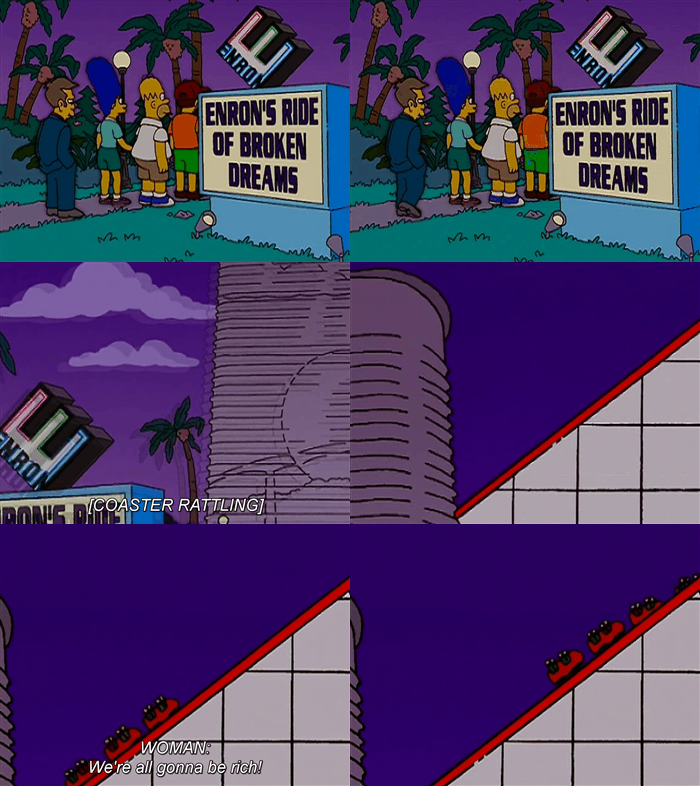
For the entry this week we’ve been ask select a brand that faced ethical or legal issues and answer the following questions. I decided to look into the biggest ethical and legal scandal that I could remember which was the Enron accounting scandal of 2001. The quick rundown version of the brand was that Enron used unethical account practices to make their loses look less bad than they actually work, claiming the potential revenue of assets on their books as soon as assets were built and not when revenue was actually earned, effectively adding value to company where there was none. While this type of accounting may work for something like security trading it’s risky business for other types of companies and caused the drastic freefall of Enron. Now that we know the gist of the situation let’s get to the questions we’ve been asked to answer!

Determine how these issues influenced consumer perceptions of the brand and how it impacted their engagement with the brand.

It may be obvious but all consumer trust in the financial ability of Enron was shattered when the unethical practices were exposed. These trust issue echoed through the market too as people became a little less trusting of the accounting practices of corporations as a whole. In the end, Enron ending up going under completely and by 2002 their bankruptcy was starting to be felt by the general public. An article from the LA Times stated the following: “Electricity and natural gas companies are facing higher costs. Projects to build power plants, pipelines and transmission lines are being put on hold. And in all sections of the economy, companies with high debts are feeling the pinch of tighter credit… these cutbacks result in power shortages and higher costs in future years, the burden will fall on consumers, according to energy experts.” Basically these unethical practices weighed heavily on the minds and wallets of consumers throughout the nation.

What were the ultimate implications for the brand?

The ultimate implications for the brand were bankruptcy, criminal charges for not only employees of Enron involved but the accounting firm they used, and, as I mentioned before, heavy financial weight felt on the nation. It took almost 15 years for Enron, now named Enron Creditors Recovery Corp, to pay off all it’s debts and though it still exists today it is listed as an inactive business and made it’s last corporate filing in July of 2016. As for Arthur Anderson, the accounting firm that was in charge of Enron, they were swiftly shut down after being charged with obstruction of justice for destroying all accounting files related to Enron when investigations began.

What should the brand have done differently, and why?

Normally in an account situation I would suggest that more checks and balances should have been in play to avoid things like this from happening but in the case of Enron this wouldn’t have mattered as the higher ups at the company were the ones controlling the account processes and even the agency in charge of doing the actual accounting work was in on it. In this case I think my biggest suggestion would be to fairly and honestly report all loses in the proper manner in the first place. While this would cause the business to not perform as well, it’s clear that the nosedive had a HUGE effect on the people involved and the country as a whole and all that needed to happen was they company reporting the proper things. That being said looking at the timeline of everything there were clearly things going on behind the scenes with employees leaving and others stepping in. If I had stepped in and discovered these issues that existed before my time there I would have done my best to address them to the public and proper government agencies, do what I could to avoid legal penalty for all involved and to keep the company afloat. At least in this situation you are doing everything possible to ensure that the general public see’s the brand as one that values honesty and integrity.

Overall this situation had ripple effects through the economy as a whole and I would not be surprised if were still feeling this issues in areas like the energy industries. A bunch of laws were created to prevent issues like this from happening in the future. I, for one, am very happy to see changes in the law reflect situation that actually occurred. I can only imagine how devastating something like this would be to our current economy if it happened today but I’m gunna go an not think about that!

References:

Flanigan, J. (2002, January 20). Enron Is Proving Costly to Economy. Retrieved December 01, 2020, from https://www.latimes.com/archives/la-xpm-2002-jan-20-mn-23790-story.html

Is Enron still in business? (2020, May 7). Retrieved December 01, 2020, from https://askinglot.com/is-enron-still-in-business

Segal, T. (2020, September 22). Enron Scandal: The Fall of a Wall Street Darling. Retrieved December 01, 2020, from https://www.investopedia.com/updates/enron-scandal-summary/

WGU. (2019, September 23). Ethical Dilemmas: How Scandals Damage Companies. Retrieved December 01, 2020, from https://www.wgu.edu/blog/ethical-dilemmas-how-scandals-damage-companies1909.html

The Importance of Brand Positioning

This week we have been asked to select and analyze a brand that we are familiar with that either successfully positioned themselves using their name, logo, or slogan or failed doing the same at any point in the brand’s life cycle. There were many brands that come to mind, from long lasting brands like Coke and Apple, and newer brands like Ulta Beauty or Spotify. For this assignment I decided to look at a brand that’s a bit smaller and close to home. Bull Moose Music is a small chain of entertainment stores based out of Portland, Maine. Currently they have 9 stores in Maine and 3 in New Hampshire (one of which I frequent often.) Not only do they sell music in all forms (cds, records, and tapes old and new) but they have new and used books, video games, board games, card games, and tons of pop culture items. Let’s look at Bull Moose Music using a few directed questions and learn more about how they position their brand to give themselves an advantage in a market that many business have seen a decrease of success in.

Examine Bull Moose Music’s mission and vision and explain how the brand name, logo, or slogan succeeds or fails to communicate the brand identity to consumers, competitors, and various stakeholders.

According to their About Us section on their website Bull Moose lists their mission statement as:

“We want to make entertainment affordable. While others charge extra for ‘deluxe edition’ this, and ‘limited’ that – we try to offer things either at or below MSRP every time because we believe that entertainment should not be a luxury. We cater to the passionate and we want to ensure that you can get the stuff that makes you happy at reasonable prices. It’s tough to wax too poetic about the business of selling stuff – but that’s just the ‘way of the moose’. Stuff (especially music & movies & books & toys) is a huge part of someone’s identity and we respect that, no matter what you’re into. If you’re picking up a $300 Beatles in Mono box set: you’re awesome. If you’re buying a $2.97 pre-owned Dave Matthews Band CD: you’re awesome. If you’re into Japanese harsh noise, that’s awesome. Listen to the Top 40 and want the latest from Justin ‘the Beeb’ Bieber? That’s awesome. If you shop at Bull Moose you’re awesome. Everything is awesome.”

Chad at Bull Moose from the About Us section on Bullmoose.com

Taking this statement you can really break down what the Bull Moose brand is: Affordable, Inclusive, Passionate. While they don’t have a slogan or motto per say I think what they call “the way of the moose” in this statement encompasses these three traits. Their ending sentiment is also very fitting as a slogan for them “If you shop at Bull Moose you’re awesome. Everything is awesome.” Specifically this “slogan” for them allows their inclusivity and passion to come out and this can also be seen in the employees in store as well who are always happy to help you find something or talk to you about something you’re already buying. The passion flows with everything they do and I think that positions them above similar companies as other entertainment sellers can feel like soulless and sanitized shops only concerned with selling the big blockbuster games or top 40 hit singles.

Facebook Header and Logo

When it comes to their logo, it’s simple, interesting and unmistakably unique which I think fits in with their overall image of being a place for all and “everything is awesome.”

What does Bull Moose Music, that successfully positioned itself, do well?

I think the biggest thing that Bull Moose Music succeeds at doing is delivering on the promises in their mission, specifically making their items affordable. When I visit I am continuously astounded by the cheap prices that can be found for all types of media at Bull Moose. Even comparing prices of some very popular titles that can be found at places like Target or Walmart they tend to have prices about 10% cheaper than those larger stores that promise “lower prices.” As I mentioned previously they also deliver on the unique and inclusive environment too, offering the passion and knowledge of smaller entertainment stores without the pretentiousness.

Using Bull Moose Music as an example, identify one or two strategies that may be applied when developing a brand name for an organization and explain how these naming strategies may help to effectively position a brand.

According to a 2019 article on Mainebiz.com, Bull Moose Music cofounder Brett Wickard says: “Some friends suggested Wickard’s Wecords and Downeast Disks — not the greatest names. I always liked Bull Moose, the name of a track club at college, and originally named it Bull Moose Enterprises, because I thought the word Enterprises sounded really big” about the Bull Moose name. Knowing this we can surmise a few different things about the Bull Moose name. It has a personal connection to the founders which can sometimes stand out more than something like the suggested examples that, to me, seem a bit derivative and limiting when it comes to possible expansion of the brand. Bull Moose has always seemed cool, yet casual, and a simple name I couldn’t forget if I tried. You don’t need to know the meaning of it to be memorable because it’s not like anything that exists out there. Sometimes you don’t need something crazy or loud to be memorable. Bull Moose Music is and will continue to be one of my favorite store to peruse and shop! 10 out of 10, would recommend!

References:

Bull Moose. (n.d.). Retrieved November 08, 2020, from https://www.facebook.com/BullMooseStores/

C. (n.d.). Bull Moose. About Us. Bull Moose. Retrieved November 08, 2020, from https://www.bullmoose.com/content/AboutUs

Cordes, R. (2019, December 9). Brett Wickard, founder of Bull Moose, says the retailer’s edge is ‘community’. Retrieved November 08, 2020, from https://www.mainebiz.biz/article/brett-wickard-founder-of-bull-moose-says-the-retailers-edge-is-community

The Benefits of Social Media Marketing (and the Chamber of Pinterest)

Here we are again ladies and gents talking about the Benefits of Social Media Marketing. If you were unaware, I have taken part of this class before (link to my initial blog post where I talk about it here) so this will be the second time I’ve completed this blog assignment. This is my Chamber of Secrets and my Deathly Hallows all in one because this is actually the last module I completed before withdrawing for the term. That means in the future all blog posts will not have a reference link to the first time I completed them. Moving on, this week we have been asked to choose between Twitter and Pinterest and discuss the benefits of marketing on said social media platform. Back in June I chose Twitter (that post can be found here if you’re interested) but this time I will go with Pinterest so let’s dive in.

Why is Pinterest a key social media channel for businesses?

I have to admit that I have never personally used Pinterest so I am definitely not an expert in its usage. I do of course know how the site works on a base level where users can post and pin images to different board and gather inspiration or further aspirational goals. An article from Hootsuite calls Pinterest a “Visual Discover Engine” and I couldn’t agree more as it allows you to search a topic and find all images with that topic. Pinterest is the only social media app offering visual search so its no wonder why it was ranked as the fourth most popular social media platform (as of December 2019.) Pinterest offers business a chance to expose their brands to over 322 million users globally and counting and according to Hootsuite “75% of Pinterest users say they’re “very interested” in new products” and “some 77% of weekly users regularly discover new brands and products on Pinterest.” This means Pinterest offers a HUGE amount of potential exposure for new brands. Not only that but there a large opportunity of ecommerce as according to an article on Sprout Social and internal data from Pinterest in 2017, “83% of weekly Pinners have made a purchase based on content they saw from brands on Pinterest.” Hearing this my big question is, why would a business NOT want to be using Pinterest?

How are Pinterest’s insights for businesses are valuable for users?

Pinterest offers businesses a large range of analytics that show companies a huge amount of different information. The following things are tracked by Pinterest analytics for businesses:

  • Impressions – The number of times your pins showed up in…
    • Home Feeds.
    • Category Feeds.
    • Search.
  • Repins – The number of times your pins were saved to boards or shared across the site.
  • Clicks – The number of times your pins were clicks and links were followed to your website.
  • Pin’s from Your Site – Can be tracked using the official “pin it” button.

As well as TOP performance information:

  • Most Viewed Pin/Board – The pin/board that received the most impressions
  • Most Re-pinned Pin – The pin that had been pinned a other boards the most.
  • Most Share Board -The board that has been shared across the site the most.
  • Most Clicked Pin – The pin with the most clicked link.

This information is the key to businesses understand how marketing materials they post are performing on the platform. When you know how your posts are performing you can figure out what works best and what doesn’t letting a company shift gears and make the most of their efforts. This is a very brief rundown of what Pinterest has to offer in terms of analytics but from what I now know it’s a hugely viable marketing platform.

References:

Driver, S. (2018, September 4). How to Use Pinterest for Business. Retrieved September 23, 2020, from https://www.businessnewsdaily.com/7552-pinterest-business-guide.html

Sehl, K. (2019, December 10). How to Use Pinterest for Business: 8 Strategies You Need to Know. Retrieved September 23, 2020, from https://blog.hootsuite.com/how-to-use-pinterest-for-business/

SNHU COCE Assistive Technology (Producer). (2016, December 28). MKT-355: How to Use Pinterest Analytics [Video file]. Retrieved September 23, 2020, from https://www.youtube.com/watch?v=2Gt1S9YdxTs

Zote, J. (2020, March 12). 9 clever ways to maximize the value of Pinterest for business. Retrieved September 23, 2020, from https://sproutsocial.com/insights/pinterest-for-business/

Role of Social Media (Take Two)

Another week, another redo blog post. If you don’t know what I mean by that I highly recommend checking out last weeks post (linked here) for a run down. This week we have been tasked to choose from one of the given social media platforms and talk about our personal experiences with the marketing on that platform. When I originally completed this assignment I decided to choose Facebook as it was a platform I didn’t use a much and had chosen YouTube for my week one blog. If you’re interested in reading the post about Facebook feel free to follow this link here. This time around I’m going to go all and choose YouTube as I have discussed it yet and it’s definitely my most used platform.

Let’s Get Started

What kinds of marketing do you see on YouTube?

YouTube is my favorite social media platform because it’s home to a huge array of different video content. From channels about video games, food, community drama, world event, music and much more, there seems to be a never ending supply of different things to explore. Along with this content comes numerous forms of marketing so let’s run over the ones I see most frequently on site. First there are the banner/display ads. These ads sometimes run on the top or sides of websites and you see them everywhere, Facebook, news websites, and even YouTube. You can also get this banner type ads on the bottom of your video screen, depending on what format you are using to watch, which can be quite annoying as it covers up a part of the video until you find and click the “x” to remove em. The most common type of marketing you see on YouTube are rolling video ads, sort of like TV commercials. These ads generally come in 3 types: pre-roll, that play before the video start; mid-roll, which runs at a point designated by the creator during the video; and a post roll, which runs after a video has finished and sometimes before the end card of the video. While they are the most common, and they are the ones that usually make creators a bit of money if they post regularly, they are the most annoying in my opinion but we’ll talk a bit more about that in our next section. Before we move on we have to talk a bit about sponsored content (#ad.)

Some content on social media will be partnership between a company and a creator. These partnerships can be loose, where a company doesn’t care what you make but will pay you to put an ad read in the video somewhere, or more formal, where a company will work with a creator and dictate what the video is and how it will go. These partnerships, aka sponsored videos in the case of YouTube, are fairly frequent if you watch any of the larger creators on the platform but come with their own set of challenges. The biggest challenge/issue I’ve seen on YouTube is how creators disclose that videos as a whole or promotions are sponsored. Ethically and legally these creators should be disclosing if they have been paid to talk about a brand or product. A person making beauty content should not be getting paid to say “this blush is the best, I highly recommend it” to there 1 million followers without disclosing that they have been paid to talk about the brand. For the most part I find creators are better at doing this now-a-days. Now that we know about the types of marketing on YouTube, let’s talk about how it’s reflected in my personal life.

How is this marketing reflected in your personal life?

Basically I am fully aware of how these examples of marketing thrown at me everyday I am on YouTube. I often have YouTube on in the background while I am doing other things so I usually will hear an ad, look up, skip it if I can, and move on. This is especially true when it comes to mid-roll ads as I find those the most annoying. Most creators don’t make videos knowing where the mid-rolls will be places so unlike when watching a TV show they can sometimes cut off the video mid sentence, or in a strange place. I can’t say I’ve ever clicked through a mid-roll ad, at least on purpose, and I have definitely not purchased anything from one BUT I can’t say that about sponsorships.

I am a person who likes to try different things and finding out about new products or services from sources that I trust is always helpful. I don’t know if most people would consider influencers “trusted sources” but for me I think I would (depending on the influencer of course.) I purchased a Quip Toothbrush using a code from Jenna Marble’s and Julien Solemita’s podcast (press F to pay respects to the podcast.) I’ve tried out a ton of different makeup products because of beauty “gurus” and even bought those spicy Korean instant ramen packets because of a food YouTuber. The one thing I can say about all of these purchases is that I don’t regret a single one because I have enjoyed the things I have purchased.

Marketing Implications (Part Deux)

No you’re not having deja vu, this IS the second time you may be reading a blog about the marketing implications of social media platforms. The reason for that is back in May/June of 2020 I ended up withdrawing from my Social Media Marketing Strategy course as with the pandemic and the protests my head was in a different place and I felt unable to properly learn. After a bit of a break I am back and ready to get educated! My plan for any blog that are being completed for the second time is to reference or quote them but always write the blog a second time. I figure this will give me a chance to say things I may have missed the first time or that may have had multiple options. Now, on to the task at hand!

This week we have been asked to “choose one social media network from the following list: LinkedIn, Facebook, Instagram, Twitter, Pinterest, or YouTube; and discuss the marketing implications of the social media network.” The last time I completed this assignment I chose YouTube but this time I’d like to talk about something I’ve been using a lot more since the pandemic and that’s Twitter!

What are the marketing implications of Twitter and how do they tie into your personal use?

According to an article on the HootSuite blog the social media platform Twitter has 145 million active users and is somehow only the fifth most active social media site as of May 2020. Twitter has a great array of uses when it comes to marketing some of which you may not even realize. Of course we know that Twitter is used by brands to share their voice, message, and products with a massive audience. Some brands are better than others at creating lasting impressions that stick in our minds and never let go, Wendy’s classic clap back tweets always come to mind. Twitter is also a great platform for gathering and using data. When it comes to gather data there’s no better information than finding out what your target audience is saying about your brand and your competition. This allows a company to then adjust their approach to better fit their desired audience. Data from other websites is also used, like on most website, to serve relevant promoted posts to users and to suggest new followers for those using the platform. I can’t tell you how many times I’ve looked at a website, decided to wait to make a purchase, and then get a bunch of sponsored posts on Twitter basically goading me in to purchasing (do it, you know yo want to!)

This all ties into my personal use of Twitter because I am surrounded by these posts every day. One of the most recent accounts I have followed is the account for the video game that is sweeping the world called Fall Guys. Basically a video game version of the TV WipeOut, Fall Guys has been advertised all over Twitter and while I already purchased it I can see how their presence on Twitter can entice those who haven’t. The Fall Guys Twitter is HILARIOUS, with it’s own running gag (they still haven’t deleted the yellow team yet,) sneak peaks into the future of the game (give us Big Yeetus,) and a heavy feature of user generate content or UGC. Everyday retweet fan art, Twitch stream clips, and they even gave away a brand new character skin early to a random user and there was a massive hunt to find out who it was. Right now their running a contest for the users to write Twitter posts over the next few weeks as the guy who usually is behind the account is “going on vacation.” I think they way they keep the fan base active and engaged is why they are successful.

Do you respond to those marketing implications? If so, provide a personal example. If not, explain why.

This answer is a bit of a grey area for me on Twitter. I definitely follow brands that I enjoy but I’ll be honest when I say I rarely get pulled in to trying a new brand because of their Twitter or an advertisement I see on Twitter. On social media sites like Twitter and Facebook I tend to put the blinders on when it comes to advertising. I rarely click on something unless it really pops and catches my eye. Honestly I don’t think I have had that happen on Twitter since I started using it. I’m sure it will happen eventually as I used to be able to say the same thing about Instagram until fairly recently.

Do you have a personal connection to any of the marketing implications? Please provide an example.

When I did this section for YouTube I had a TON of connections to the marketing implications there as I follow influencers and will often try a brand they recommend or have affiliate codes with. For Twitter though it’s definitely less so. Obviously I follow brands I enjoy (Fall Guys, Taco Bell, Urban Decay Cosmetics, Holo Taco Nail Polish) and if these brands put out something new that catches my eye I’m more likely to make a purchase because am invested in these brands. That’s really all the connection I have when it comes to Twitter though but I think that’s enough because that’s the goal of a brand on social media, grow a following and continue to get them to buy. Damn! I fell right into their trap.

Fall Guys

References:

Cyca, M. (2020, May 06). Twitter Marketing: The Complete Guide for Business. Retrieved September 04, 2020, from https://blog.hootsuite.com/twitter-marketing/

Course Recap

Last blog of the class and that means some recap questions to answer. So, no chit chat or crazy GIFs this time let’s get down to business!

Sorry, I couldn’t help myself!

What was the most interesting thing you learned over the past eight weeks about social media marketing campaigns?

I think the most important thing I learned about social media marketing campaigns was just how important choosing the correct target audience is and going directly to where they are to market to them. You can plan to focus on a certain group of people but if that group of people is the smallest on the only platform you plan to market it you’re wasting your time and money for a small return. It would be like a company targeting LGBT+ men advertising on Tinder or Bumble, instead of Gindr or Scruff. (Is that too niche of an example? Hope not.)

What were your thoughts on the weekly blogs?

Honestly I found the weekly blogs a great way of gathering my thoughts about the weekly topic and receiving feedback from my peers. While discussions give you this a bit too you tend to see more of a persons personality in the more loose format of a blog assignment which makes the blogs enjoyable to read and respond to. I always try to ad a bit of fun to my blog posts with gifs or images and I hope those brightened up people’s days a little bit.

What were your likes/dislikes?

In terms of the class I didn’t really have any dislikes as it was pretty fun, at times challenging in the best way, and there was always a lot of feedback given as well as chances to ask questions. When it comes to likes and dislikes of the blogs themselves I think I really enjoyed the format and the frequency didn’t feel like overkill. If we talking about the social media campaign final project I think it was a great way to get experience actually making a campaign instead of just reading about how they can be made. I especially enjoyed the creativity of making the posts for the final submission. I actually got two of my friends to supply pictures of make up looks they did and used them as examples of user generated content that we would use in our campaign. It was so much fun!

The last thing I want to say, and I think I said it in my last blog post as well, is that I wish everyone in this course the best of luck on everything they do in the future. It’s been great getting to work with you all and I hope that maybe we’ll get the chance again in the future.

Final Thoughts

This week feels a bit somber as we have been asked to give our final thoughts regarding our marketing campaign, are we nervous, excited, relieved, etc?

I’m definitely excited to see how my marketing campaign goes over as I really do find a lot of fun in creating such campaigns. I haven’t yet completed the creative executions that we are tasked to add to our final product submission this week but in the past actually creating facsimile ads/marketing has been one of my favorite things to do. After submitting some created social media posts for a class I was previously in I actually had a teacher tell me that I “wasn’t allowed to just pull posts of the internet,” and I “needed to create my own posts.” I felt kind of proud telling her that I had actually created all of the posts that I included and she apologized stating that they looked so real she couldn’t tell the difference. A little tip for those who choose to read my post this week, there are many different online sites you can use to create “fake” social media posts for different platforms. Don’t be afraid to play around and make sure to look at the brands real social media accounts so you can make them look as real as possible, down to the username and profile image.

Other than that there definitely comes a bit of sadness that the class is almost over and that I am almost completely finished with my campaign. I’ve worked really hard to come up with this campaign and it’s a bit of a shame that it won’t be something I continue with. Who knows though, maybe someday I’ll end up working with a company like Urban Decay cosmetics on their social media. Wouldn’t that be a trip?!

I want to take a second to say good luck to everyone on their final projects. Thank you for all the responses to my posts and blogs, and its been great seeing all of your hard work! Great job everyone!

The Key to Social Media Success Within Organizations

Cats.

That’s it. That’s the blog post and the key to social media success within organizations. Thank you and goodnight….

…just kidding, of course. This week we’ve been tasked with reading an article called The Key to Social Media Success Within Organizations. In the article, the authors (Quy Huy and Andrew Shipilov) argue that the main reason some social media initiatives fail to bring benefits to companies is because the initiatives do not create “emotional capital,” which they define as a strong emotional connection between stakeholders and the company. We’ve been tasked with discussing our own definition of watch emotional capital means, whether we agree or disagree with the authors opinions, and why. If you’ve read ANY of my posts before this you can probably assume how I feel about this topic already but let’s dive into it with my definition of “emotional capital.”

What is “Emotional Capital?”

If I had to define the phrase “Emotional Capital,” and I do as part of the assignment, I would have to say it is a way of quantifying a persons feelings towards a specific thing which can have different connotations depending on the situation. When it comes to a business I usually think of a company fostering a positive “Emotional Capital” from their consumers about their brand or product. This can be done many ways but the most common we see now-a-days is via social media. Basically companies try to create a positive connection with their brand. In the case of the article we are discussion companies using social media to stimulate a positive “emotional capital” internally within a company. Now that we know a bit about “emotional capital” we can analyze the article and the authors opinion.

Opinions (The Authors and Mine)

In the article Andrew and Quy talk strongly about how companies fail to bring about the benefits of social media initiative because they are not creating “emotional capital.” They’ve even gone as far to research and found that “Executives whose social media initiatives had increased emotional capital for their company reported that social media made it easier to communicate both across hierarchical levels (vertical communication) and functional units (horizontal communication). However, companies where social media had not increased emotional capital found that social media had little impact on the ease of communication in the company and in some cases even aggravated existing problems.” They mention how implementation of podcasts and wikis as forms of communication are also effected by the fact that “emotional capital” was being built using social media. What I found particularly interesting is that if “emotional capital” was built using social media in the workplace and a wiki was used an increase in communication was felt about 3 times the amount as it was prior, where only a minimal increase was felt without “emotional capital.”

I feel pretty strongly about this idea of “emotional capital” on internal social media as I currently work for a company that uses internal social media and wiki’s that I don’t feel is building “emotional capital.” At the company I work for we have a Facebook-esque “app” called Chatter that we can use to ask questions, talk about issues, and even get responses from some of the higher ups in the company. We also have a wiki that we use for all policy and procedural information called Knowledge Base. I honestly can tell you that there has been no attempt to create any sort of emotional connection with my company using Chatter and that’s such a shame. I think it could be a great tool to get stores talking to each other more, offering solutions to everyday problems, and tips about things that need to be improved. It’s highly unfortunate that it’s as underutilized as it is. The wiki we have is also pretty bad as it’s not exactly user friendly. You can search terms but they need to be pretty specific and there not a great way of sending someone an article. I usually will call a coworker to ask a question before going here to get answers.

Paired together I think Chatter and Knowledge base could be great tools to increase communication throughout the entire company but due to the lack of “emotional capital” they’ll probably just continue to go on mostly unused. All this being said I heavily agree with the sentiments of our authors in this case as I think it makes so much sense. You’re creating a personal connection with a persons workplace, that instills pride and a sense of important to a place that can easily just feel like somewhere you go to just to get a paycheck. I’m interested to see if anyone else has any experience with internal work social media platforms and what they are like. The article this week was great and highly worth a read if you’ve got the time. For now, it’s time get out of here and find some cat videos.